Vintage Halloween Decor: 4 Retro Styles to Try This Year
A $40 skeleton with light-up eyes looks identical in every house that buys it — same mold, same paint job, same three stores it came from. That’s the problem with most Halloween decor on the shelf right now. Nothing about it suggests a specific year or a specific place it came from. It just looks like this October, mass-produced.
Vintage pieces don’t have that problem, and after digging through collector forums and old decorating archives to put this guide together, the reason becomes pretty clear: a real vintage piece carries visible signs of having existed before this year — a faded color, a hand-drawn wobble in the printing, a material nobody really uses anymore.
There’s a catch before you start shopping, though. A lot of what gets sold under “vintage Halloween decor” online isn’t actually vintage by any definition collectors use, and knowing the difference changes both what you should pay and where you should be looking.
Vintage, Retro, and Reproduction Aren’t the Same Thing
This matters more than it sounds like it should, because it changes what you’re paying for.
By the standard collector’s definition, vintage means an item was genuinely made 20 to 99 years ago — it’s a real object from the era it looks like it’s from. Retro means something new, made this year or last year, styled to look like it came from an older decade. Reproduction sits in between — a deliberate, often licensed remake of a specific old design, like Beistle reprinting the same die-cut patterns from its own 1920s archive.
None of these are “fake” or lesser than the others. But they do have very different price tags and very different shopping strategies. A genuine 1930s German die-cut can run into the hundreds of dollars because so few survived. A reproduction of that same design, printed today from the original artwork, might cost eight dollars. If you’ve been searching “vintage halloween decor” and getting frustrated that some listings are $200 and others are $9, this is why — you’re looking at three different categories mixed into one search result.
For most people decorating a house, not building a museum shelf, reproduction and retro pieces do 90% of the visual work for a fraction of the cost. Save the real hunting for one or two genuine pieces you actually want to own long-term.
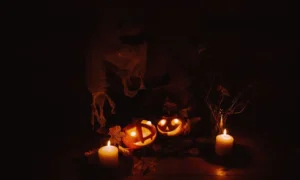
Where the Look Actually Comes From
The American version of this starts earlier than most people guess. Dennison Manufacturing put out a Halloween-specific catalog, the Bogie Book, back in 1909 — mostly paper goods, table settings, party favors. Beistle followed not long after and is still, remarkably, printing Halloween decorations from that same era of artwork today, out of the same town in Pennsylvania.
The pieces collectors chase hardest are the German-made die-cuts from roughly 1919 to 1935. Germany’s economy was in rough shape after the first World War, and small home workshops there produced these hand-finished paper decorations for American department stores. They stopped being made once the political situation in Germany changed in the mid-1930s, which is exactly why so few exist now and why the ones that do survive aren’t cheap.
Skip forward a few decades and the material changes completely. Blow-mold plastic — those hollow, lit-from-inside pumpkins and ghosts — showed up in the 1950s and 60s from companies like Union Products and General Foam Plastics, and those same companies, or their successors, are still making nearly identical molds today. If your image of “vintage Halloween” is glowing plastic on a porch rail, that’s a 70-year-old manufacturing process, not a recent trend.
If “90s Halloween” Is the Nostalgia You’re Actually Chasing
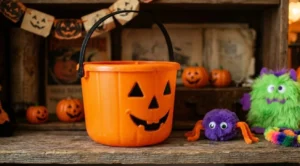
A lot of people search “vintage halloween decor” but the image in their head isn’t gothic or antique at all — it’s a specific plastic bucket.
If you’re a millennial, there’s a good chance you can picture exactly which one. McDonald’s introduced its Halloween pails in 1986 — three of them, McPunk’n, McBoo, and McGoblin — as the container for a Halloween Happy Meal. They came back nearly every October through the 90s with small redesigns each time: a green McWitch joined the lineup in 1989, and by 1990 the ghost version glowed in the dark, which was, for a lot of kids that age, a genuinely big deal. The buckets kept evolving through the 90s and 2000s before eventually going on hiatus in 2016 — and then coming back in 2022 to a wave of adult nostalgia nobody at McDonald’s probably expected.
That’s the specific texture of 90s Halloween decor that a generic “bright colors and plastic” description misses. It’s not just an aesthetic — it’s a shelf of very particular objects a lot of people already have a memory attached to. If that’s the version of nostalgia you want in your house, you’re not looking for antiques. You’re looking at flea markets, eBay, and old craft-fair leftovers for:
- Plastic blow-mold pumpkins, ghosts, and candy buckets from the same manufacturers that made them originally
- Purple paired with orange and black — the color combination that shows up constantly in 90s Halloween packaging specifically, more than in earlier decades
- Rubber masks, window clings, and the puffy-paint craft aesthetic from school Halloween parties
- Cassette-era classroom decor: foam tombstones, paper garlands, hand-lettered signs with a slightly crooked, homemade look
None of this is rare or expensive yet, which makes it the easiest and cheapest entry point on this whole list. What it isn’t is elegant — it reads as fun and familiar, not sophisticated, and that’s the honest trade-off.
The Moodier Direction: Gothic Vintage
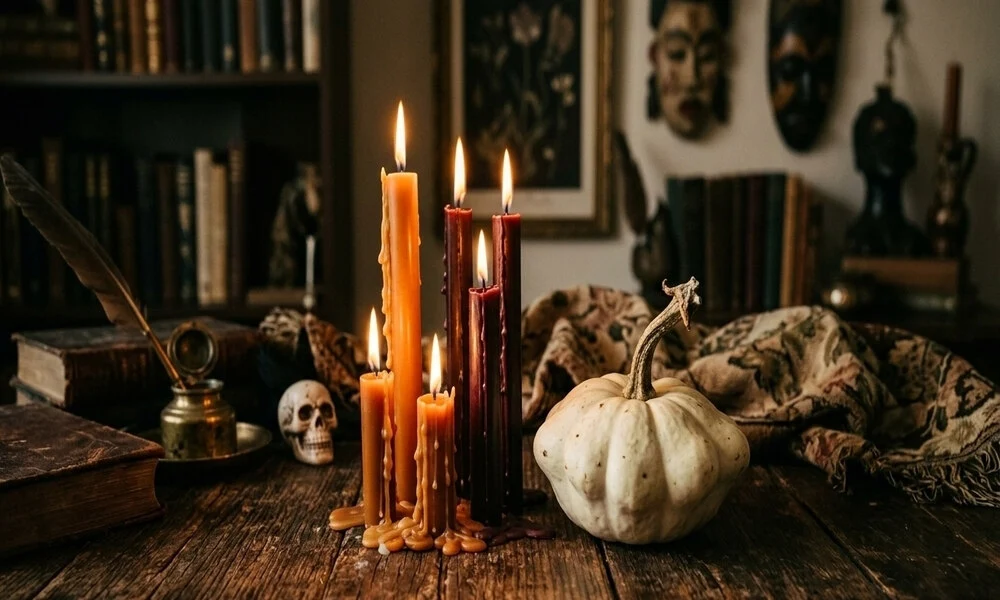
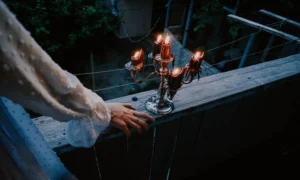
If plastic buckets aren’t your nostalgia and you want something that looks closer to that 1920s German die-cut era instead, the palette shifts entirely — burgundy and black instead of orange and purple, candlelight instead of a plug-in glow.
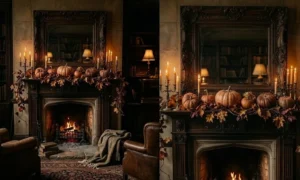
This look leans on a handful of well-chosen objects rather than a full shelf of them: a real or reproduction brass candelabra, an antique-style frame with a printed vintage Halloween illustration inside it, a faux raven, apothecary-style bottles with handwritten labels. Old books work here in a way they wouldn’t in the 90s look. So does actual tarnish.
The trade-off is patience. You’re not filling a cart in one sitting — you’re picking up one good piece at a time, from an estate sale or a secondhand shop, over a few weeks. But because the look depends on restraint, three or four strong pieces genuinely carry an entire mantel or entry table.
The Handmade Direction: Primitive Folk-Art Vintage
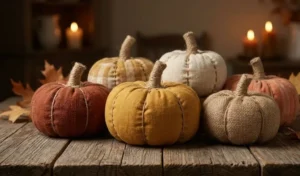
This one isn’t tied to a manufacturer or a decade at all. It goes back to homemade harvest decorating — fabric pumpkins stitched from old flannel, a black cat cut from scrap wood, a mason jar with a candle in it instead of a battery light. Mustard, rust, and faded orange instead of true black or bright orange.
If your house already does farmhouse or cottagecore decor the rest of the year, this style won’t feel like a seasonal costume change — it’s the same visual language, just Halloween-flavored. The catch is time, not money. A hand-stitched fabric pumpkin is a real project, not a five-minute craft. If that sounds relaxing, this is the most satisfying option here. If you want to be done decorating by Sunday afternoon, skip it.
An Actual DIY Project: Aging Paper for Any of These Looks
Most of what makes vintage Halloween decor look old isn’t the object itself — it’s the paper. Here’s the technique that does most of the work, whichever style you’ve picked:
What you need: plain white or cream cardstock, a shallow dish, brewed coffee (cooled), a paintbrush or sponge, and a hair dryer or a sunny windowsill.
- Brew a strong cup of coffee and let it cool to room temperature — hot coffee will warp thin paper too fast.
- Lay your cardstock flat and dab the coffee on unevenly with a sponge or brush. Don’t aim for a solid, even coat — the blotchy, uneven spots are what read as “aged” instead of “colored.”
- Press a few coffee grounds directly onto damp spots for deeper, freckled staining, then shake them off once dry.
- Let it air-dry flat, or speed it up with a hair dryer on low heat. It’ll curl slightly as it dries — that’s normal and actually helps the aged look.
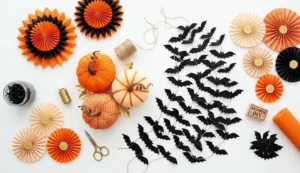
- Once dry, cut your pumpkin, cat, or bat shapes, or print a vintage-style illustration onto the stained paper before cutting.
A single sheet costs you a cup of coffee. Multiply it across ten sheets and you have a full mantel garland or a set of framed pieces for the price of what you’d spend on filters and grounds anyway.
Where People Undo the Whole Look
One glossy or neon piece in an otherwise faded room. A single bright green plastic spider sitting in a room full of burgundy and cream doesn’t read as an accent — it reads as a mistake, because it’s the one thing your eye can’t place in any era.
A modern font on any hand-lettered sign. Clean sans-serif “Happy Halloween” text will date the whole display to right now, no matter how old everything around it looks. A serif font, an old circus-style typeface, or actual handwriting keeps the illusion intact.
Ignoring your era’s actual palette. Faded orange, black, and cream belong to the earlier decades. Orange, purple, and black belong to the 90s look. Lime green, hot pink, and glitter belong to neither — they’re modern additions that break whichever era you’re trying to recreate.
Picking One
Honestly, the right answer here has less to do with Halloween and more to do with how you already live the rest of the year. If your house already leans dark and antique, gothic vintage will feel like it belongs there. If a plastic McDonald’s bucket makes you feel eight years old again, that’s the nostalgia worth chasing, not a “more sophisticated” look you don’t actually care about. If you already reach for burlap and mason jars every fall, the folk-art direction is barely a detour.
None of these are more “correct” than the others. They’re just different memories, and different Octobers.
For more seasonal directions beyond just the vintage angle, our Halloween decor ideas for 2026 guide covers the rest of the house too.
A Few Questions Worth Answering
Is “retro Halloween decorations” the same as vintage?
Not technically. Retro means new items made to look old, while vintage means the object itself is actually old — generally 20 to 99 years, by the collector’s rule of thumb. In practice, though, most people typing either phrase into a search bar are picturing the same general look, so it’s less about picking the “correct” term and more about knowing which one gets you a $9 item versus a $200 one.
Can I mix the gothic and 90s looks together?
It works better as an accent than a 50/50 split. A single plastic blow-mold pumpkin sitting next to gothic candelabras can read as an intentional, playful contrast. A room split evenly between the two usually just looks like two different people decorated it.
Do I need real antiques for any of this to look convincing?
No — and for most people, you shouldn’t bother. A thrifted five-dollar frame holding a printed vintage illustration does almost the same visual job as an original from the 1920s. Save the real collecting for a piece you’d actually want to keep for its own sake, not because a room needed it.