12 Green Accent Wall Bedroom Ideas That Don’t Turn Muddy in Real Light
Here’s something most green accent wall bedroom guides won’t tell you: sage green already peaked. Good Housekeeping’s design coverage from earlier this year tracked it — the color hit its high point back in 2023 and 2024. The question going into 2026 wasn’t whether it would fade. It was whether it would stabilize instead. It did. Designers aren’t dropping sage green, they’re just done painting entire rooms with it. It’s shifted from “whole-room commitment” to “the accent color that never left” — bedding, one wall, a headboard nook, not all four walls.
That shift matters if you’re about to pick up a paint brush, because it changes which of these 12 ideas actually makes sense for 2026 versus which ones were already dated by 2025.
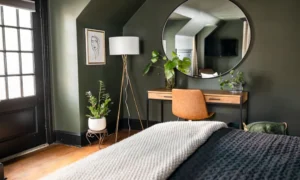
Why Green Accent Walls Keep Working When Full Rooms Don’t
A muted, desaturated green is one of a small handful of colors that design researchers keep coming back to for bedrooms specifically — not for looks, but for how it affects sleep. Saturated, bright color is stimulating. Muted, gray-leaning color isn’t. That’s the entire reason a soft green accent wall reads as restful instead of decorative.
Full-room green rarely holds up over years. One wall does, mostly because it’s a smaller bet — you’re not betting the whole room on a color trend, you’re betting one wall.
The LRV Table Nobody Includes (And Should)
Every green paint has a Light Reflectance Value — a number from 0 to 100 that tells you how much light the color bounces back versus absorbs. This number matters more for bedrooms than almost any other room, because it decides whether your accent wall still looks like a color at 9pm or just looks black.
| Green family | Typical LRV | How it reads in a bedroom |
|---|---|---|
| Soft sage (gray-green) | 40–55 | Calm, airy, works in almost any light |
| Smoky gray-green (like Evergreen Fog) | 28–35 | Moody but warm, needs decent daylight |
| Olive / earthy green | 20–35 | Organic, nature-led, wants some sun |
| Forest / deep green | 6–15 | Dramatic and cocooning, best as a single wall only |
| Mint / pale green | 60–75 | Light and fresh, can go cold in shade |
Sherwin-Williams Evergreen Fog (SW 9130) — the 2022 Color of the Year that’s still everywhere in green accent wall bedroom photos — sits right at LRV 30. That’s a real number, not a marketing description: dark enough to feel grounding on one wall, light enough that it won’t swallow a whole room the way a true forest green does.
If Evergreen Fog feels overused (it’s in almost every green-bedroom gallery at this point), two newer 2026 options worth sampling: Behr’s Hidden Gem, a smoky blue-green pitched as this year’s “new neutral,” and Valspar’s Warm Eucalyptus, which leans more botanical and warm. Neither has saturated Pinterest yet, which means less chance your bedroom looks identical to everyone else’s.
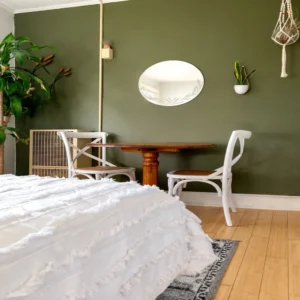
The Floor Problem Most Green Accent Wall Guides Skip
Wood floors carry undertones — orange-leaning in a lot of honey oak, pink in some red oak, gray in whitewashed oak. Green paint carries undertones too. When the two clash, the room looks slightly off in a way that’s hard to name until you’ve seen it happen.
Warm honey floors next to a blue-leaning green can look muddy together. The same warm floor next to a yellow-leaning olive or moss green usually reads as intentional. Gray or whitewashed floors pair more easily with cooler, blue-leaning greens like Hidden Gem. Hold the actual paint chip against your actual floor before buying — not against a screen, not against a white wall.
Matte vs. Eggshell: The Finish Decision That Changes Everything After Sunset
Matte hides wall imperfections but absorbs light. In a small or dim bedroom, a matte deep green can feel like it’s closing in once the sun goes down. Eggshell or satin reflects a little more, so the same color holds some life after dark — the trade-off is it shows a few more flaws on an older or bumpy wall.
Twelve Ways to Do This, Not Fifteen Padded Ones
Most lists like this stretch to a round number by splitting one idea into three. Cutting that here — these are twelve genuinely different approaches, each with the actual trade-off attached.
Full-Height Behind the Headboard
Paint the wall floor to ceiling, but stop it at roughly the outer edge of the bed frame plus 4 to 6 inches on each side — not the whole wall corner to corner. That margin is what makes it read as a deliberate accent instead of an accident that ran out of tape. Skip this if your ceiling is under 8 feet; full-height color in a low room makes the ceiling feel closer than it is.
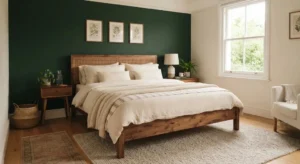
Two-Tone at Chair-Rail Height
Green from the floor to about 32–36 inches up (standard chair-rail height), white or warm off-white above. This carries less visual weight than a full wall, and it’s the one version that genuinely works in rooms with 7.5-foot ceilings without making them feel shorter. The mistake people make here: painting the split too high, closer to 48 inches, which just looks like an unfinished paint job instead of an intentional line.
Nook or Alcove Only
If you’ve got a recessed reading nook, a window seat, or even just a shallow alcove, paint that section instead of a full wall. You get the same LRV-30 depth as a full Evergreen Fog wall, at a fraction of the square footage and the cost of paint. This is the version to pick if you’ve never worked with a saturated color before and want to test your own reaction to it before committing further.
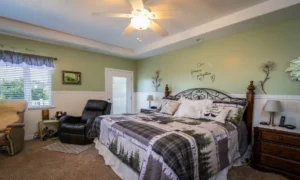
Botanical or Textured Wallpaper
Peel-and-stick or traditional botanical-print wallpaper instead of paint. Two real advantages over paint: it’s removable if you’re renting, and a textured grasscloth-style paper hides minor wall dents and old nail holes that flat paint would show up under raking light. The downside — it’s typically double or triple the material cost per wall compared to two coats of paint, so this is the pricier route, not the budget one.
Behind Open Shelving, Not the Bed
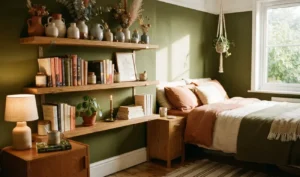
Paint the wall behind a shelving unit or dresser instead of the bed wall. The green becomes a backdrop that styling sits against, rather than the first thing you see walking in. This is the gentlest entry point on this list — if you’re nervous about color at all, start here, not at the headboard wall.
True Forest Green (LRV 6–15), If Your Room Gets Real Sun
This is the one idea on the list I’d actually talk someone out of if their bedroom is north-facing or gets under 3 hours of direct light a day. At LRV 6–15, forest green needs real daylight to read as a color instead of just reading as a dark wall. If your room qualifies, pair it with brass hardware and warm-temperature bulbs (2700K, not daylight white) — cool white light on a dark green wall is the fastest way to make it look flat and lifeless instead of rich.
Panel Molding, Then One Coat of Green
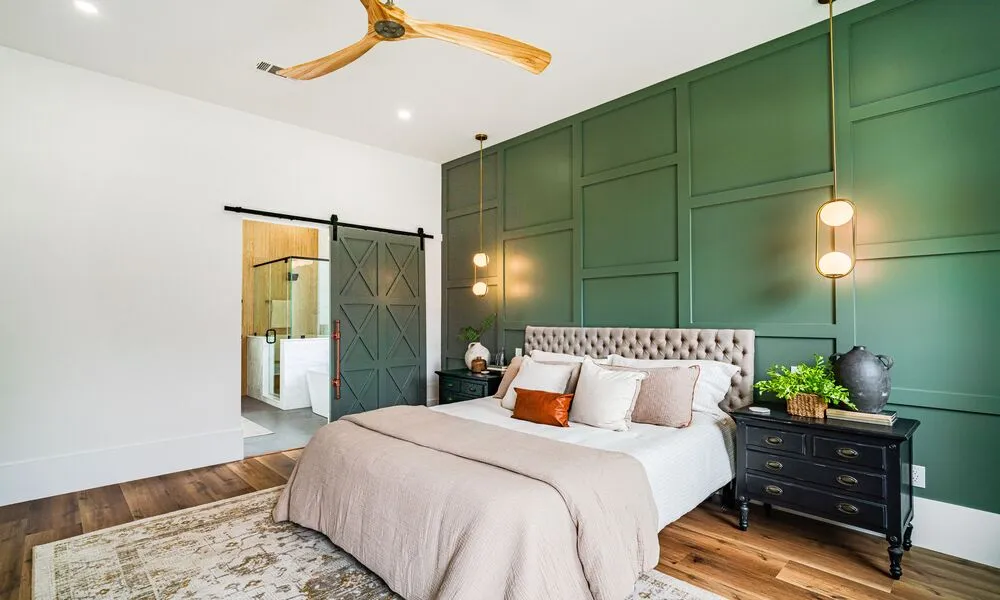
Add simple picture-frame or shaker-style molding to the wall before painting, then paint molding and wall the same green. The raised lines catch real shadow throughout the day, which gives a flat wall texture that a single coat of paint alone can’t fake. Budget for the molding itself, not just the paint — this is a full weekend project, not an afternoon one.
Olive Green With Rattan and Cane
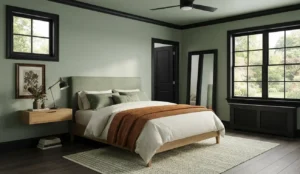
Pair a warm olive wall (LRV 20–35) with a rattan or cane headboard and a woven pendant light. The natural fiber texture keeps olive — which can lean slightly retro on its own — from feeling dated. Watch the undertone here specifically: olive next to cool gray flooring is one of the more common clashes on this whole list.
A Floating Bed Frame Against a Full Wall
For a platform bed that doesn’t touch the wall, more of the green shows around the edges of the headboard than with a flush bed frame — the color visually reads as covering more of the room than it actually does, without painting a single extra square foot. Pairs well with either Evergreen Fog or the newer Warm Eucalyptus, since both hold their depth without needing the wall to be huge.
Green Paired With Terracotta, Not White
Deep green walls with terracotta or rust-colored bedding and pillows, instead of the more common white-and-green combination. This leans warm and earthy rather than cool and moody — the difference matters if the rest of your room already has warm wood tones, since white-and-green can sometimes read a little cold against warm oak or walnut furniture.
Two Greens Split Horizontally
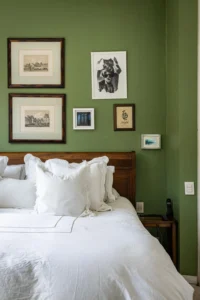
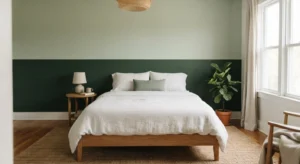
A darker green on the lower half of the wall, a lighter sage on the upper half, split at roughly the same chair-rail height as the two-tone idea above — but green on both sides instead of green-and-white. This reads more considered than a single flat coat, though it’s easy to get the two shades too close together and end up with something that just looks like a botched paint job in bad light. Pick two colors from the same paint strip (the vertical color card), not two unrelated greens, to keep them related enough to look intentional.
Skip the Wall Entirely — Sage as the Accent
This is where 2026 is actually heading, per the trend data above: sage green in the bedding, a headboard, or a bench at the foot of the bed, with the walls left neutral. If you’ve read this whole list and still aren’t sure you want to commit to a painted wall, this is the version that gets you the color with zero repainting risk later.
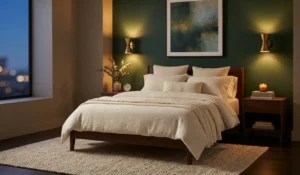
Three Things That Go Wrong With Green Accent Walls
Testing the color on a screen instead of your actual wall. Screens correct color automatically. Paint doesn’t. This is the single most common regret in green accent wall bedroom projects.
Choosing matte in a room with limited afternoon light. A matte, low-LRV green in a dim room can look almost black by evening. Eggshell holds more of its color after dark.
Assuming “sage” means the same thing across every paint brand. It doesn’t. Test the specific color, not the color family name — one brand’s sage can lean gray, another’s can lean yellow-olive.
Frequently Asked Questions
Is a green accent wall still relevant for bedrooms in 2026, or is it dated?
Stabilizing, not dated. Design coverage through 2026 shows sage and muted green settling in as a long-term bedroom staple — just shifting from full-room paint to accent walls, bedding, and smaller touches rather than fading out entirely.
What’s the safest green if I’ve never done a bold wall before?
A gray-leaning sage in the LRV 40–55 range. It won’t go too dark in low light and it pairs with most wood tones without much undertone risk.
Does the LRV number actually matter that much for a bedroom?
Yes, more than for almost any other room. Bedrooms get used at night, when natural light disappears entirely — a low-LRV green that looked rich at 2pm can look flat black by 9pm.
How do I know if my floor will clash with the green I want?
Hold the actual paint chip against your actual floor in daylight. Warm floors generally pair better with yellow-leaning greens like olive or moss. Cooler, gray, or whitewashed floors pair better with blue-leaning greens.
Test the sample against your actual floor and in your actual evening light before buying the full gallon — that single step prevents most of the regrets on this list.
SEE ALSO: 20 Sage Green Living Room Ideas That Feel Calm (2026)