Bedroom Layout Ideas for Awkward or Oddly Shaped Rooms
If you have ever stood in the middle of your bedroom trying to figure out where the bed is even supposed to go, you already know the problem. Most bedroom decorating advice assumes a plain rectangular room with one flat wall for the headboard.
Real homes are not that simple. Sloped ceilings, narrow footprints, corner windows, and awkward alcoves are extremely common, especially in older houses, converted attics, and small apartments — and almost no one writes about them properly. If you enjoy browsing general bedroom decor ideas, this guide goes a step further and tackles the layout problem those articles usually skip.
This guide covers bedroom layout ideas for awkward rooms that are actually built for irregular shapes, not just squeezed into them. Every idea below has been tested against real layout problems, not just imagined for a photo.
Quick Answer
For an awkward or oddly shaped bedroom, the fastest fix is almost never a new furniture set — it is repositioning what you already own. Place the bed where the ceiling is highest and the wall is longest, even if that is not the wall directly across from the door. Use low, flexible furniture (open nightstands, floating shelves, slim dressers) in tight corners instead of bulky pieces, and treat sloped ceilings, radiators, and alcoves as storage opportunities rather than obstacles to work around.
Bedroom Layout Ideas for Awkward or Oddly Shaped Rooms
Before changing anything, it helps to understand why these rooms feel so hard to plan in the first place. Once you know the actual problem, the layout fix becomes obvious.
Why Your Awkward Bedroom Feels Impossible to Arrange
Standard furniture is built for standard rooms. A queen bed frame, a full-size dresser, and a pair of matching nightstands are all designed with the assumption of four flat walls and enough clearance on every side. When your room has a sloped ceiling that cuts into the space, a window placed off-center, or a chimney breast eating into one wall, that standard layout simply does not fit — and most people respond by cramming furniture in anyway, which is one of the same small bedroom layout mistakes that make a room feel smaller we’ve covered before.
The real fix is to stop trying to force a symmetrical layout onto an asymmetrical room. Once you plan around the room’s actual shape instead of an imagined “ideal” layout, awkward corners and odd angles stop being a problem and start becoming useful space.
Sloped Ceiling Bedroom Layout Ideas
Sloped ceilings, common in attic conversions and top-floor apartments, are one of the most common “impossible” layouts people write in about. The key is understanding headroom, not floor space.
- Place the bed under the lowest point of the slope, not beside it. You do not stand up in bed, so the lowest ceiling height is actually the safest spot for it. This frees up the taller part of the room for movement and dressing.
- Use the sloped wall for built-in or low storage. Short bookshelves, under-eave drawers, or slim baskets fit naturally into the triangle of space a sloped ceiling creates, which is usually wasted otherwise.
- Skip tall furniture near the slope. A tall dresser or wardrobe against a sloped wall will look like it is fighting the room. Keep tall pieces on the flattest, tallest wall instead.
- Add a floor lamp instead of a hanging pendant if the slope makes ceiling height inconsistent near the bed — it avoids awkward head-clearance issues entirely.
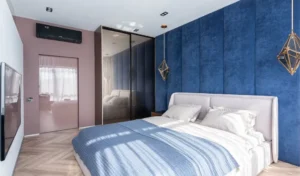
Narrow Bedroom Layout Ideas (Long, Thin Rooms)
Narrow bedrooms create a different problem: not enough width to fit a bed and still walk around it comfortably. A few adjustments make a real difference.
- Push the bed against the longer wall instead of centering it on the shorter one. This is the single biggest layout mistake in narrow rooms — centering the bed on the short wall eats up all your walking space on both sides.
- Choose a bed without a footboard. In a narrow room, footboards visually and physically shorten your usable floor space.
- Use one nightstand, not two. A single narrow shelf or floating nightstand on the accessible side keeps the walkway clear without sacrificing function. If you’re also working with a tight budget, our cozy bedroom decor ideas on a budget has more low-cost furniture swaps that suit narrow rooms well.
- Mount a mirror on the wall opposite the window. This is a simple trick that genuinely makes narrow rooms read as wider, because it bounces natural light down the length of the room.
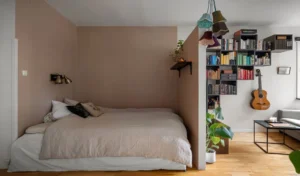
Corner Window Bedroom Layout Ideas
A window placed in the corner of a room, rather than centered on a wall, throws off almost every “standard” layout guide. Instead of fighting it, use it.
- Angle the bed into the opposite corner if the room allows it. This is one of the only situations where an angled bed placement genuinely works better than a straight one, because it balances the asymmetry of the window.
- Turn the window corner into a reading nook instead of trying to place furniture directly under or beside it. A small chair and a slim side table use the corner without competing with the window.
- Keep curtains simple and off to one side so they don’t visually compete with nearby furniture — full symmetrical drapery rarely works well on a corner window.
Working Around a Radiator, Chimney Breast, or Alcove
Old-house features like radiators, chimney breasts, and built-in alcoves are permanent, so the layout has to work with them, not against them.
- Never block a radiator with the bed frame or a solid headboard. It restricts heat flow and can damage upholstered headboards over time. Leave at least a few inches of clearance, or use an open-slat headboard instead.
- Use alcoves for storage, not the bed. Alcoves beside a chimney breast are usually too shallow for a bed to sit flush, but they are ideal for a slim wardrobe, shelving, or a desk.
- Treat a chimney breast wall as your feature wall if the bed cannot go there — it is often the strongest visual point in the room, and paint or wallpaper there does more work than trying to fit furniture around it.
Bed Placement Rules That Work in Any Odd Shaped Room
Regardless of the specific quirk your room has, a few rules hold true across almost every awkward layout:
- Aim for at least 60–70 cm of clearance on the sides of the bed you actually walk on — you don’t need equal clearance on every side.
- Keep the door swing completely clear; furniture blocking a door makes even a well-planned room feel cramped.
- Place the bed so you can see the door from a lying position where possible — it is a small detail that makes irregular rooms feel calmer.
- When in doubt, measure your room and sketch it on paper before moving anything. Odd shaped rooms punish guesswork more than standard ones do.
Key Takeaways
- Plan around your room’s actual shape, not a standard rectangular layout — this is the core fix for almost every awkward bedroom.
- Sloped ceilings work best with the bed under the lowest point and storage tucked into the low triangle of space.
- Narrow rooms need the bed on the long wall, a footboard-free frame, and a single nightstand to preserve walking space.
- Corner windows and alcoves are opportunities for reading nooks or storage, not problems to hide.
- Never block a radiator, and always keep the door swing clear.
FAQs
What is the best bed placement for an awkward shaped bedroom?
The best bed placement is against the longest uninterrupted wall, ideally where ceiling height is consistent and away from the door swing. In sloped-ceiling rooms, place the bed under the lowest point of the slope rather than beside it.
Can you put a bed under a sloped ceiling?
Yes, and it is usually the best spot for it. Since you do not need to stand up in bed, the lowest part of a sloped ceiling is actually the most practical location, and it frees up the taller area of the room for movement.
How do you make a narrow bedroom feel bigger?
Push the bed against the long wall instead of the short one, remove the footboard if possible, use a single nightstand, and add a mirror opposite the window to reflect natural light down the length of the room.
What furniture works best in an odd shaped bedroom?
Low, flexible furniture works best — open nightstands, floating shelves, and slim dressers adapt to irregular corners far better than bulky matching furniture sets designed for standard rectangular rooms.
Should I avoid putting furniture near a radiator?
Yes. Keep beds, especially those with solid headboards, at least a few inches away from a radiator to allow proper heat flow and to protect upholstery from heat damage over time.