
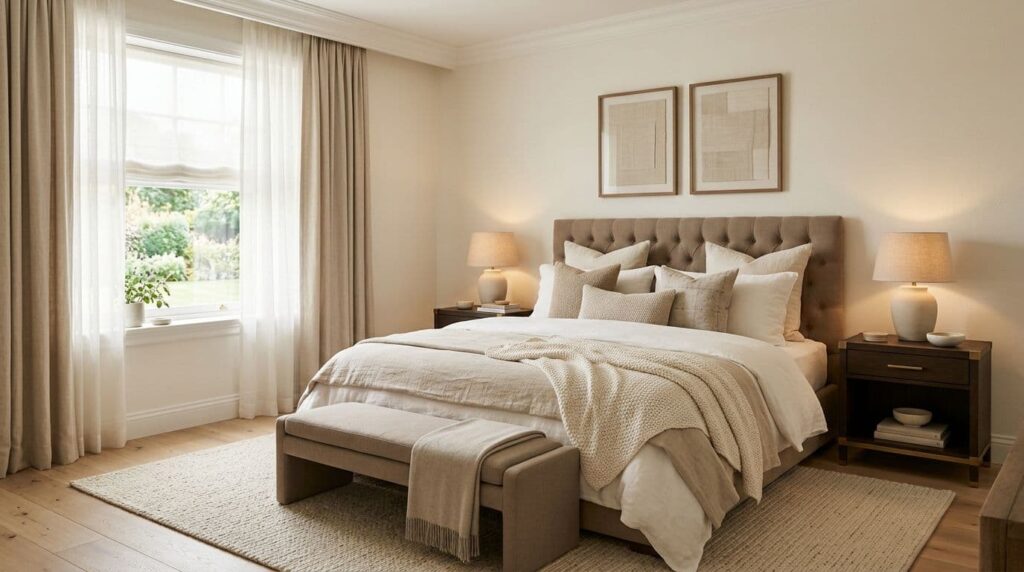
A small bedroom can feel calm, bright, and easy to live in. It can also feel tight the moment someone walks in. In most cases, the problem isn’t the square footage alone. It’s the layout.
These small bedroom layout mistakes tend to visually shrink a room, block movement, and make storage harder than it needs to be. The good news is that most of them are fixable without remodeling. A better plan for bed placement, furniture scale, light, and storage can change the whole mood of the room.
Bed placement mistakes that throw off the whole room
The bed is the largest item in most bedrooms. Because of that, its position shapes walking space, balance, and how open the room feels at first glance.
1. Placing the bed where it blocks the easiest path through the room
A bed in the main walkway makes a room feel cramped before anything else does. If the door opens and the first move is a sidestep around the mattress, the layout already feels wrong.
Designers usually clear the path from the door first. Then they place the bed on the strongest wall, often the longest uninterrupted wall, or the least disruptive wall in an awkward room. The aim is simple: get from the door to the bed, window, and closet without weaving around furniture.
In a small bedroom, open floor matters as much as floor area.
2. Choosing a bed that’s too large for the room
An oversized bed can swallow a small room whole. It steals the space needed for nightstands, walking room, and visual balance. The result is a bedroom that feels packed, even when it isn’t cluttered.
A better fix is to choose the largest bed that still lets the room breathe. In many compact rooms, that means a queen instead of a king, or a slimmer frame around the same mattress size. Guidance from Real Simple on styling a small bedroom around a large bed reflects the same idea: when the bed dominates, every other piece has to work harder and smarter.
3. Using a bulky bed frame, tall headboard, or footboard
Heavy bed frames crowd a room visually, even before storage baskets or extra pillows show up. Tall headboards, thick side rails, and footboards can make the center of the room feel blocked.
That’s why designers often switch to low-profile platform beds, simple frames, or styles without footboards. Lower silhouettes make ceilings seem higher, and lighter shapes reduce visual weight. That lines up with 2026 bedroom trends as well, since lighter, lower bed forms and vertical details are being used to make compact rooms feel calmer and taller.