How to Fit a Desk in a Small Bedroom Without It Feeling Like an Office
Gallup’s 2026 numbers put hybrid work at 52% of U.S. employees in remote-capable jobs, and most hybrid policies ask for at least three office days a week. So the other two or three happen at home, usually wherever there’s a spare surface. For a lot of people that’s a corner of the bedroom, because there’s nowhere else left — no guest room, no den, sometimes not even a dining table that isn’t already claimed by someone else in the house.
A desk in a small bedroom doesn’t need much space to work — a laptop and a coffee cup take up less room than most people assume. A full desk crammed against the wall can still start to feel like an office with a bed shoved into it, which isn’t what anyone wants at 11pm. The layout problem usually comes down to picking the right spot, not finding extra square footage that doesn’t exist. The rest of this comes down to a handful of decisions: which corner, what to swap out, how to keep the bed off camera, and what to do about sleep once the desk moves in.
Why Small Bedroom Desk Setups Became a Real Category
Video calls are part of this too. Zoom reported around 300 million daily active users in 2026, up from about 10 million before 2020. Whatever’s behind the desk on camera gets seen by coworkers, clients, whoever’s on the call — daily, for a lot of people. A bedroom desk setup isn’t just furniture anymore. It’s on camera, and the room behind it is doing double duty as a backdrop.
The Corner That’s Sitting Empty
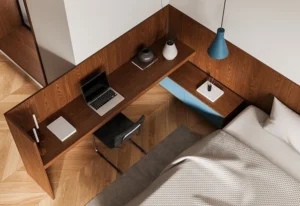
Most bedrooms have a corner that’s too small for a dresser and doesn’t line up with anything else. Put the desk there. A desk between 36 and 48 inches wide, 18 to 24 inches deep, fits into that kind of gap without touching the path from the door to the bed. If the corner is genuinely tiny — under 30 inches on either side — a floating wall-mounted shelf desk takes up even less, since it skips legs entirely and just needs wall space.
Replace the Nightstand Instead
When there’s no spare corner — bed on one wall, closet on the other — Laura Price, founder of The Home Organisation, recommends putting the desk where the nightstand would go. Same spot next to the bed, still room for a lamp, but now it doubles as a desk during the day. Most nightstands only hold a lamp and a phone charger anyway. This only works on one side of the bed, obviously — the other nightstand stays a nightstand, or gets swapped for a slim shelf instead.
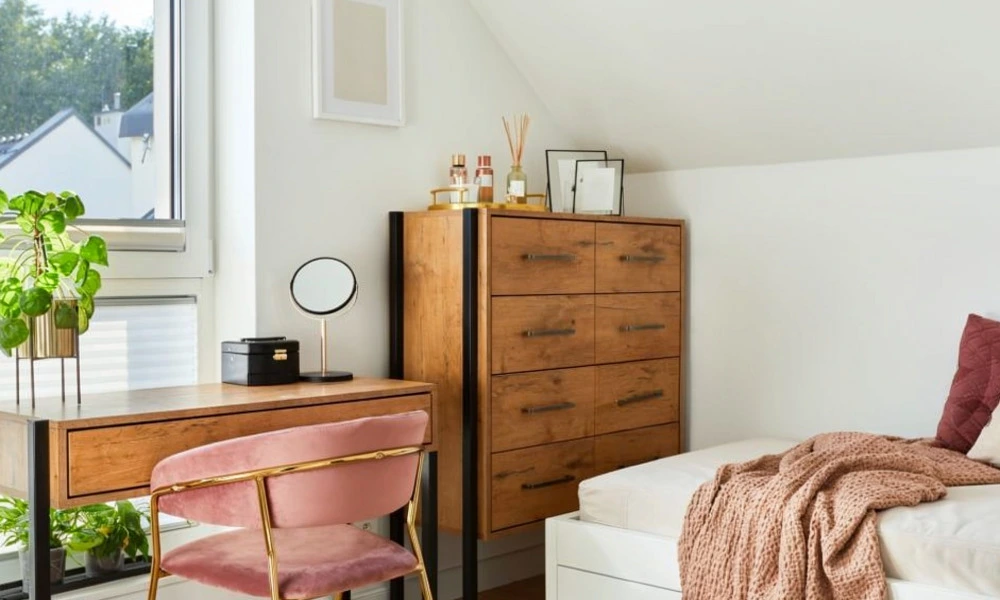
A Desk That Also Works as a Vanity
Louise Wicksteed, design director at Sims Hilditch, recommends placing a desk near a window when the room allows for it — good for the work itself, and it helps on video calls too. If there’s no window near the desk spot, a decent lamp gets close enough.
Using the Closet
A “cloffice” — closet plus office — is a closet with a slim desk shelf built into part of it. Close the door and the desk disappears completely, which is the main reason people go this route instead of anything else on this list. It works when there’s unused hanging space or an empty shelf section in the closet. It doesn’t work when the closet is already packed floor to ceiling. A shelf at desk height, a stool low enough to tuck fully inside, and an outlet run along the back wall covers most of what’s needed — no need to gut the closet or add a second door.
What’s Behind You on Camera
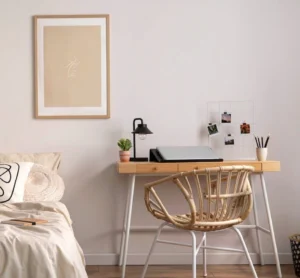
Face the desk toward the bed and every video call shows an unmade bed, or there’s a scramble to fix it before 9am. Face it toward a wall, a closet door, or a curtain instead. A cheap folding screen behind the chair works too if there’s no wall option — under $30, and it stores flat when not in use. Even a tall plant or a bookshelf placed between the desk and the bed does part of the job, since the camera crops out whatever’s directly behind it.
Working From Bed Actually Hurts Sleep
This one isn’t about the layout so much as the habit. Working from bed makes it harder for the brain to treat that spot as a place for sleep instead of email. A desk, even a small one, keeps the two apart. Closing the laptop and turning off the lamp at the end of the day works as a signal that the workday is over, not paused.

No Corner, No Closet: A Fold-Down Desk
Some rooms genuinely don’t have a spare corner or wall. A wall-mounted, fold-down desk closes flat when not in use and opens into a full surface. It can’t hold a heavy monitor setup long-term, and it has to be mounted into studs, not drywall alone — worth checking before assuming it’ll handle two monitors. Most fold-down models top out around 40-50 lbs of working weight once open, which covers a laptop and a small monitor, not much more.
Renters and Wall Weight Limits
Command-strip shelving and lightweight floating shelves usually top out around 15-25 lbs, which is fine for a laptop shelf or a small lamp mount but not a monitor arm. A freestanding desk that needs no wall hardware at all is the safer bet in a rental. If the lease allows small anchor holes but not drilling into studs, a light corner shelf desk rated under that weight limit is usually the workable middle ground.
Small Bedroom Desk Dimensions to Plan Around
Behind the chair, leave 36 inches of clearance so there’s room to push back and stand without hitting the bed frame. The desk itself: 36 to 48 inches wide, 18 to 24 inches deep, covers a laptop and a notebook without eating the wall.
Matching Desk Size to Budget
A laptop-only setup works on a $50-80 desk, or even a wall shelf. Add a monitor and cable management becomes worth paying for — a mid-range desk with a grommet hole and a drawer. A two-monitor setup with an external keyboard is really the only case where a bigger, sturdier desk earns its space in a small room, and at that point it’s worth asking whether the bedroom is even the right room for it. There’s also a middle option a lot of people skip: a secondhand or floor-model desk from a local listing site, which often runs a third of retail for something with real drawers and a solid top instead of particleboard.
Lighting the Desk, Not the Room
Overhead light works for getting dressed. It’s too harsh for evening work if the desk sits near the bed, and it’s usually not focused enough for actual tasks. A desk lamp aimed at the surface helps more than most people expect, and it’s kinder to a partner or roommate trying to sleep in the same room — flip on a lamp instead of the ceiling light. On video calls specifically, a lamp positioned slightly in front of the face rather than overhead avoids the harsh under-eye shadow that overhead bedroom lighting tends to create.
Vertical Storage
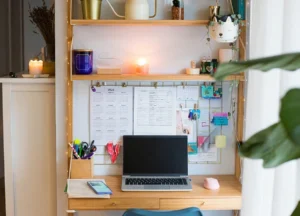
Artem Kropovinsky, founder of Arsight, favors vertical storage for small spaces specifically — shelves and drawer units that build up instead of spreading across the floor. A hutch, a couple of floating shelves, or a pegboard above the desk keeps supplies close without taking more floor space. A wire or wall-mounted file sorter does the same job for paperwork that would otherwise pile up on the desk surface itself, which matters more in a bedroom than in an actual office, since there’s no separate drawer cabinet to hide it in.
Sharing the Room With Someone Else’s Sleep Schedule
A partner on a different shift, or naps during the day, changes the calculus. Put the desk as far from the bed as the room allows. A quieter keyboard, headphones instead of speaker audio on calls, a lamp instead of the overhead light — small things, but they’re usually what makes or breaks a shared-room setup, more than the actual floor plan does. Even the chair matters here: a hard-wheeled office chair on a wood or laminate floor is loud enough to wake someone up, and a rug or chair mat under it cuts that down without needing to buy quieter furniture.
Cables and the Charging Situation
A desk in a bedroom usually needs to charge more than a laptop — phone, headphones, sometimes a tablet or a second monitor. Running one power strip along the back of the desk instead of multiple cords trailing across the floor keeps the corner from turning into a tripping hazard, which matters more in a small room where the desk sits close to the walking path. A cord clip or two along the desk leg stops cables from swinging into view during calls as well.
Testing the Spot Before Buying Anything
Before ordering a desk in a small bedroom, it helps to tape out the footprint on the floor first — desk width, chair pulled out, the swing of the door. Stand in it for a minute. If the tape square blocks the closet or sits in the walking path, that’s worth knowing before the desk shows up, not after it’s already assembled. This costs nothing and takes less time than reading reviews for three different desk models.
Where to Start
A dead corner is the easiest starting point for a desk in a small bedroom, if there is one. If not, the nightstand swap or the closet usually work before a fold-down desk becomes necessary. Size the desk to the actual gear being used, not the biggest one that technically fits.
The full small bedroom layout guide covers the walkway and furniture rules for the rest of the room. If the desk ends up near a window, this guide to positioning a bed around an off-center window covers a related problem, since the same window often affects both pieces of furniture. For rooms where the whole layout is a puzzle beyond just the desk, this guide to oddly shaped bedrooms goes further into it.
A desk in a small bedroom works when it stays out of the way of everything the room is actually for. Pick the spot that gets in the way the least, keep the storage off the floor, and shut the laptop at the end of the day.