How to Position a Bed With an Off-Center Window (5 Real Fixes)
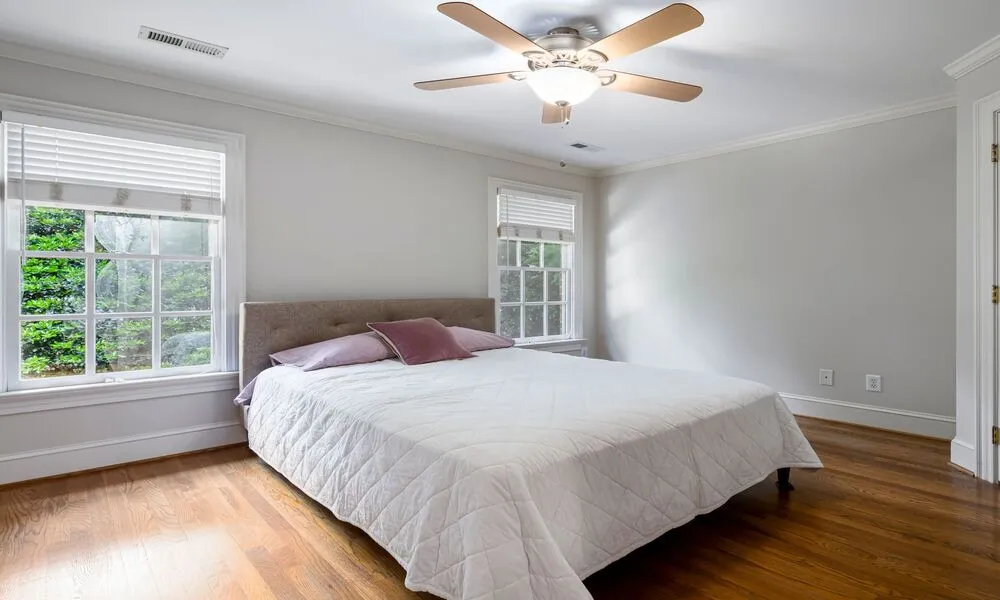
Pull up any “bedroom layout” board on Pinterest and you’ll notice something: almost every photo has the window sitting neatly in the middle of the wall, bed centered underneath it, a nightstand balanced on either side. Then you go measure your own room and the window sits eighteen inches off to one side. Center the bed on the wall and it’s half on glass, half on drywall. Center it under the window instead and the whole thing drifts toward one side of the room — sometimes right into the swing path of the closet door.
That gap between the Pinterest photo and your actual wall has a name: an off-center window. It’s one of the most common bedroom layout headaches nobody actually warns you about before you move in.
Nothing is actually wrong with the room. It’s just refusing to look like the photo.

Why an Off-Center Window Happens in the First Place
Off-center windows aren’t rare — they’re just rarely explained. Older homes get additions and interior walls get moved, which leaves a window that used to sit in the middle of a bigger room now stuck near the edge of a smaller one. Mid-century houses in particular loved corner windows, which look great from the street and create a genuine puzzle for anyone trying to fit a bed and two nightstands against that same wall. Some bedrooms have two windows instead of one, spaced in a way that makes centering anything between them mathematically impossible without a nightstand hitting a closet door.
It’s architecture built for a different furniture arrangement than the one the room actually needs now. Even brand-new construction isn’t immune — a window placed to satisfy an exterior elevation, or to clear a plumbing stack on the floor below, doesn’t always land where a bedroom’s furniture actually wants it. The window was never designed around the bed. That’s the whole issue, and it explains why no single trick works in every room.
First, Figure Out Which Problem You’re Solving
Before picking a fix, it’s worth being honest about what’s actually bothering you, because there are two different problems hiding inside “my window is off-center.”
Some people want the window to look centered — the glass itself, the light coming in. Others don’t care about the window at all; they want the wall to feel balanced once the bed, art, and furniture are all in place. Chasing both at once is usually where people get stuck, because the fix for one doesn’t always help the other.
The Curtain Trick That Fixes It Without Touching the Window
The most reliable fix, and the one that shows up across almost every design blog that’s tackled this problem, doesn’t touch the window at all. It fakes the width instead.
Chicago-based interior designer Jennifer Rizzo has run into this exact layout problem with multiple clients, and her go-to solution is drapery: mount the curtain rod wider than the window itself, extending further on the short side than the long one, and hang it close to the ceiling rather than directly above the window frame. Once the curtains are drawn even partway, the eye reads the fabric-and-window combination as one wide, centered feature — not a small window stuck off to one side.
It only works if the fabric matches on both sides. Same weight, same fullness, even though one side is covering more bare wall than glass. That symmetry in the curtains is what tricks the eye. Mismatched panels — one noticeably thinner or shorter than the other — undo the whole effect immediately.
There’s a real trade-off worth knowing before buying hardware: wider curtains block more of the window when closed, and if a wall sconce was planned for the side that now has fabric running past it, that spot might need a table lamp instead. It’s a small sacrifice for a fix that otherwise costs nothing but a curtain rod — which is exactly why it works in rentals as well as owned homes.
When the Wall Has Two Windows Instead of One
This version sounds worse but is often easier to solve.
The instinct is to center the bed between both windows. Interior design blog Chris Loves Julia ran into exactly this while redesigning a client’s long bedroom with two off-center windows and closets on the opposite wall — and centering the bed between them didn’t work. The nightstand kept running into a closet door, and the layout felt like it was fighting the room instead of working with it.
Their fix: center the bed under one window, dress that window with full, dramatic curtains, and leave the second window bare or minimally treated. The dressed window becomes the wall’s visual anchor — the spot your eye actually lands on — while the second window just reads as extra daylight. Treating two windows differently on purpose, instead of forcing them to match, is often what makes a two-window wall finally feel resolved.

Going Bigger: Covering the Whole Wall in Drapery
For a window problem that feels too big for a single curtain rod, some people cover the entire wall — window, blank drywall, and all — floor to ceiling in fabric. It’s dramatic, and it makes an off-center window disappear completely, since the eye reads the whole wall as one continuous textile moment rather than a window plus some empty wall.
It’s not for everyone. A full wall of fabric collects dust, which matters if allergies are a factor, and it needs a ceiling-mounted track to look intentional rather than improvised. If the budget and the upkeep both work, it’s one of the only fixes that makes the window a total non-issue. If not, it’s more commitment than most off-center windows actually require.
Balancing the Window With Art or a Mirror
For a lot of people, this ends up being the simplest option: skip the curtain math and hang something — art, a mirror, a woven wall hanging — on the side of the bed that doesn’t have a window. It rebalances the wall without touching the window treatment at all.
The real hesitation isn’t usually aesthetic. It’s the idea of a heavy framed piece hanging directly above where someone sleeps. Writer Arlyn Hernandez, who covers exactly this dilemma for the design blog Style by Emily Henderson, flagged the same worry when working through her own off-center window — and it’s a fair one whether or not earthquakes are a local concern, since gravity doesn’t need a fault line to be a problem. A few practical ways around it: pick a piece with a lightweight frame and acrylic glazing instead of glass, use fabric or a woven hanging that genuinely can’t do damage if it ever came loose, or pull the headboard an inch or two away from the wall so anything that did fall would land behind the bed instead of on it.
Done well, this is often the lowest-effort fix on the list — no new curtain hardware, no fabric yardage, just one piece hung with intention on the side that needs the visual weight.
Let the Headboard Do the Balancing
A wide or asymmetrical headboard can visually stretch the bed across the wall, so the window ends up reading as part of one larger composition instead of an odd afterthought stuck off to the side. Some headboards extend further on one side than the other on purpose — sometimes into a built-in shelf or an attached nightstand — which shifts visual weight toward whichever side of the wall needs it.
This matters most when the window sits close to the bed and there isn’t much room to play with curtains at all. A narrow, boxy headboard tends to make an off-center window more obvious, since it creates a tight, separate rectangle right next to the glass. A wider or upholstered one softens that edge and pulls focus back toward the bed.
![wide upholstered headboard positioned beside an off-center window]](https://cozyluxuryhome.com/wp-content/uploads/2026/08/wide-upholstered-headboard-positioned-beside-an-off-center-window-300x208.webp)
Or, Just Let the Window Be Off-Center
Sometimes the real fix is deciding symmetry was never a requirement to begin with. A perfectly centered window-and-bed setup is a preference, not a rule, and plenty of well-designed rooms lean into asymmetry on purpose — a floor lamp on one side and nothing matching on the other, a stack of books, a single tall plant filling a gap that would otherwise sit empty.
If this is the route, the goal isn’t to hide the imbalance — it’s to make it look chosen. Something that gives the eye a place to land on the more open side reads as arranged, not incomplete. Oddly enough, this tends to look more finished than a near-symmetrical attempt that almost lines up but not quite. Half-symmetry reads as a mistake in a way full asymmetry doesn’t.

“Why Don’t You Just Move the Bed?”
This is the first suggestion almost everyone gets, and it’s rarely as simple as it sounds. In a lot of rooms, there genuinely isn’t another wall that works. The door might swing directly into whatever corner the bed would need to occupy. The wall perpendicular to the window might already be committed to a closet or the only spot that fits a dresser and TV. Shifting the bed to center it under the window might free up floor space on paper while leaving an oddly empty gap on the other side — too small for furniture, too big to ignore.
If rearranging has already been tried and nothing else fits, that’s not a failure of imagination. Some floor plans genuinely only have one workable wall for the bed, off-center window included. In that case, the curtain trick, the art, or the headboard fix above are doing real work — not just papering over a problem that could have been solved by shifting furniture five feet to the left.
Special Cases for an Off-Center Window
High windows. Some homes — single-story ranch builds especially — have windows set several feet off the floor. Curtain tricks that work beautifully on a floor-to-ceiling window can look strange here, since long panels hanging from a small, high window don’t behave the same way visually. Art, shelving, or a headboard fix usually reads better in these rooms than forcing a drapery illusion.
Windows close to the bed. If the headboard sits right against the glass, direct sunlight can fade both the fabric and the bedding over time. A UV-blocking window film is worth considering here no matter which layout fix gets chosen — it solves a problem the layout alone can’t.
Corner windows. Common in mid-century homes, these create an especially tight puzzle since there’s glass on two intersecting walls instead of one flat one. Stretching a blind or shade past the actual window frame — the same principle as the curtain trick — tends to be the most workable fix, since it visually claims more of the corner than the glass alone does.
Where to Start When You Have an Off-Center Window
The curtain trick is the lowest-risk, most reversible option, and it works in the widest range of rooms, rentals included, since it only needs a curtain rod rather than a wall change. It’s also the cheapest starting point — a rod and a pair of panels costs far less than a new headboard or a custom art commission, which makes it worth trying first even if the room ends up needing a second fix layered on top. If curtains alone don’t finish the job, layering in art or a headboard on top usually does. For the walkway and furniture rules that apply no matter where the window sits, the full small bedroom layout guide covers that ground. And since an off-center window changes how much natural light reaches each side of the room, this guide to layering small bedroom lighting is worth a look once the bed is in its new spot. For rooms where the window is really just one symptom of a bigger awkward layout, this guide to oddly shaped bedrooms covers more of the same balancing principles.
None of this comes from personal design experience — it comes from digging into how people who solve this problem for actual clients, and people who’ve simply lived with an off-center window in their own bedrooms, have handled it. The right fix depends on the room, the budget, and how much the asymmetry genuinely bothers you versus how much you’ve just been told it should. Start with the lowest-effort option, live with it for a week, and adjust from there.