Small Kitchen Trends 2026: What Designers Are Actually Changing This Year
If you have a small kitchen, you’ve probably noticed that most “2026 kitchen trends” roundups are shot in rooms with a 12-foot island and two ovens. None of that transfers to a real apartment kitchen, and most of it was never meant to.
New apartments built in the U.S. now average just over 1,050 square feet, down about 7% from a year earlier. Inside a unit that size, the kitchen itself usually lands somewhere between 70 and 100 square feet — small enough that the National Kitchen and Bath Association classifies it as a small kitchen from the start, not an exception to a bigger standard. Whatever’s trending has to actually work in that footprint, or it’s not really a trend for this kitchen. It’s just a photo of someone else’s house.
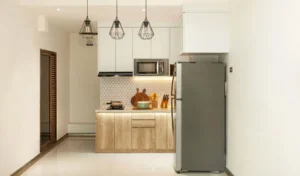
The Shift: From Hiding the Size to Designing Around It
For years, “small kitchen” design mostly meant disguise. All white, everything reflective, nothing bold enough to draw attention to how tight the room actually was. That approach is fading. Rebecca Hughes, an interior designer who works often in compact London kitchens, told Homes & Gardens that her clients are increasingly treating a small kitchen as a chance to be considered and even a little brave, rather than something to apologize for. Her specific move for 2026 is a mirrored or antique-finish backsplash — something with texture and a bit of imperfection to it, which bounces light around the room while also giving it a sense of depth that a flat white tile never quite manages.
That’s the real story behind small kitchen trends this year. It’s not about tricks that make a room look bigger than it is. It’s about materials and choices that would work in a large kitchen too, scaled down and applied with more intention because there’s less room for anything accidental.
Pattern Is Showing Up on the Floor, Not Just the Backsplash
This one surprised me a little when I first read it, because pattern has usually been treated as a “go big or don’t bother” move — something for a mudroom or a large open-plan kitchen with room to absorb it. That’s changing. Molly Torres Portnof, founder of DATE Interiors, has been bringing painted checkerboard flooring into small kitchens specifically, pairing it with neutral, organic materials elsewhere in the room so the pattern has somewhere to land instead of competing with everything else.
The reason this works in a small space and not just a large one comes down to scale control. A checkerboard pattern painted directly onto existing wood flooring is a weekend project, not a floor replacement, and you control the size of each square. Go smaller than you’d use in a big kitchen — an oversized pattern in a tight galley just reads as busy — and it adds warmth without eating the room’s sense of proportion the way a bold wallpaper or a patterned backsplash might.
Lighting Is Getting Softer, Not Brighter
Small kitchens have historically been over-lit, on the logic that more light equals more space. Designers are backing off that idea for 2026. Franky Rousell, founder of Jolie Studio, points to milk glass and other diffused, pearlescent finishes on pendant lighting as the direction for small kitchens specifically — fixtures that soften the light instead of just adding more of it, which brings a warmth that a bare bulb or a stark linear fixture doesn’t.
This matters more in a small kitchen than a large one for a practical reason: in a tight room, you’re standing closer to every light fixture in the space, so harsh light reads as harsher. A diffused pendant over a sink or a small prep area does the job without turning the whole room shadowless and flat.
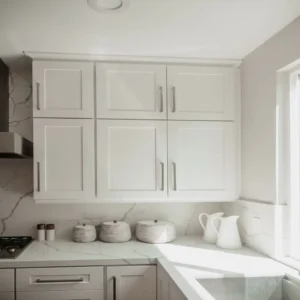
Two Directions on Color, and They’re Not Actually in Conflict
Here’s where it gets a little more complicated than most trend lists let on, because two things are happening in kitchen color at once, and they look like opposites.
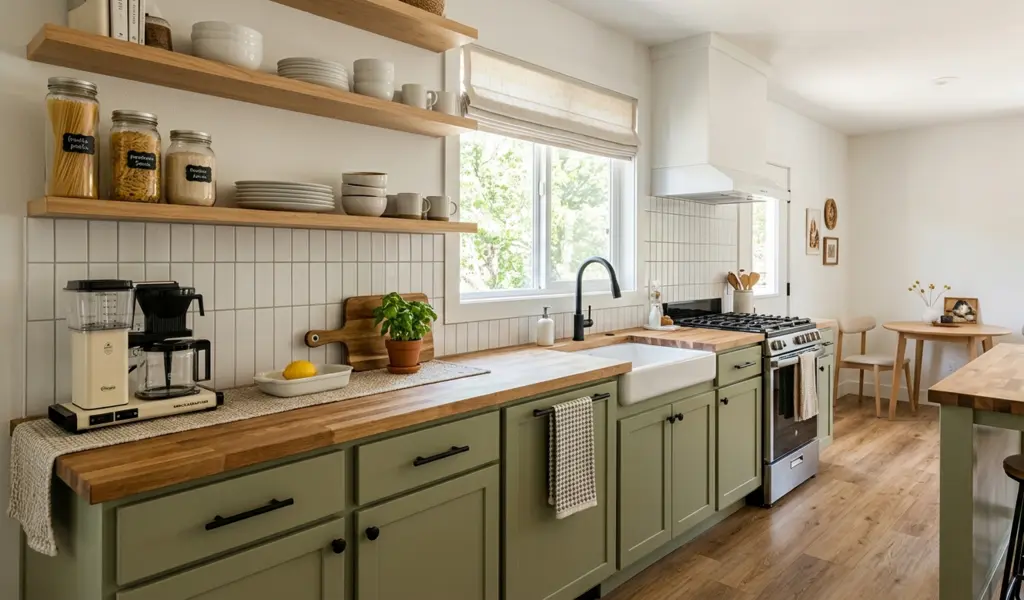
On one side, Natalie Rebuck, principal designer at Re:Design Architects, told Homes & Gardens, has been steering clients toward warmer neutrals — clay, taupe, muted greens, natural wood tones — as a reaction against the all-white and all-gray kitchens that have dominated for a decade. On the other side, Helen Parker, creative director at deVOL Kitchens, is seeing real demand for the opposite: dark, saturated cabinetry in colors like burgundy and deep plum, specifically because a small kitchen can carry a moody color in a way a large one sometimes can’t. Her reasoning is that “small” doesn’t have to mean “safe” — a compact room done in a rich, enveloping color reads as intimate and considered, not cramped.
These aren’t actually contradicting each other. Both are a reaction against the same thing: sterile, characterless neutrals that were chosen because they were safe rather than because anyone particularly wanted them. Warm neutrals and dark, saturated cabinetry are two different answers to the same complaint. Which one fits your kitchen mostly comes down to how much natural light the room gets — a dark, moody palette needs a kitchen that gets reasonable daylight or good layered lighting, or it can genuinely feel like a cave rather than cozy.
Storage Is Going Vertical, and Appliances Are Disappearing Into the Cabinetry
You can’t add square footage to a small kitchen, but you can add height, and that’s where most of the real functional change is happening in 2026.
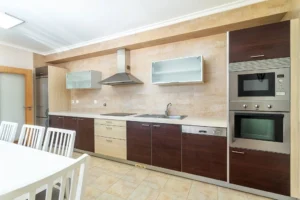
Jamie Miller, sales and design lead at Ayr Custom Cabinetry, told Real Simple, has been building cabinetry that runs floor to ceiling and hides appliances behind matching fronts, which keeps a small kitchen visually uniform — the room reads as more spacious because there’s less visual noise breaking it up, even though nothing about the square footage changed. Manny Kavouklis, president of CMK Construction, points to the same mechanism from a different angle: floor-to-ceiling storage pulls the eye upward, which is what actually makes a room feel taller.
The appliance side of this is worth its own mention. Kimberly Oxford, of Kimberly Oxford Interiors, has noticed that in compact kitchens, visual clutter builds up faster than in a large one, simply because there’s less room for the eye to rest. Panel-ready appliances — a dishwasher or fridge with a cabinet-matching front installed over it — used to be a high-end option reserved for larger renovations. In 2026, they’re becoming close to standard in small-kitchen projects specifically, because hiding the appliance fronts does more visual work in a tight room than it does in a bigger one. Rich Kingly, a renovation expert, adds that pocket doors and appliance garages serve the same purpose for smaller items — the goal across all of it is removing things the eye has to process, not adding more storage capacity for its own sake.
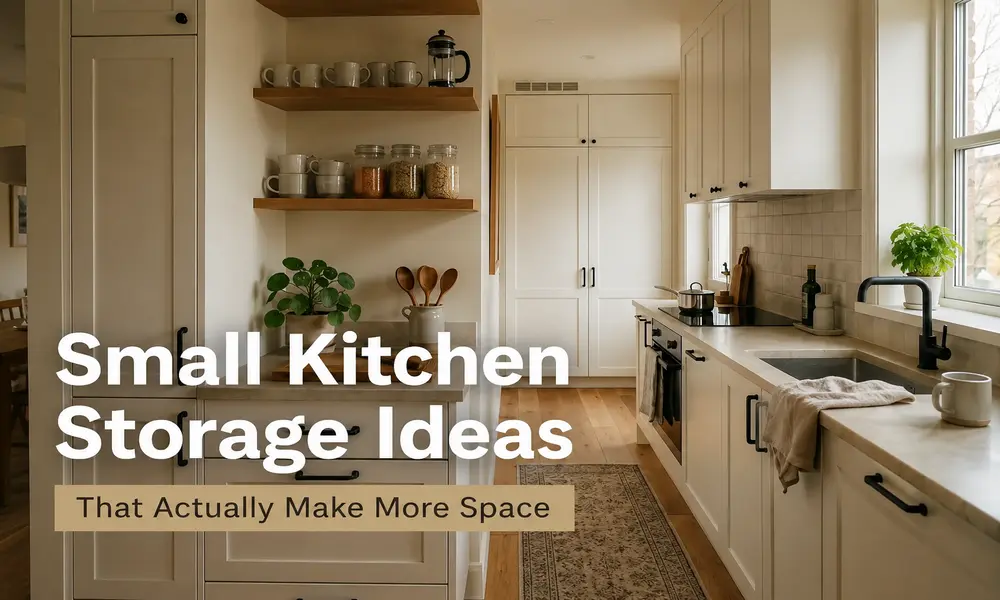
If you want the specific products and layouts for doing this in your own kitchen, this guide to small kitchen storage goes into that in more depth. The trend itself, at its core, is simple: stop treating your upper cabinets as if they have to stop two feet below the ceiling, and stop treating your appliances as things that need to be visible to be useful.
Hardware Has Two Camps Right Now, and They Disagree
Matte black hardware has been the default choice for close to a decade, and it’s losing that position — but not for one single replacement. Two different directions are both getting real traction for 2026, and it’s worth knowing both before you pick one.
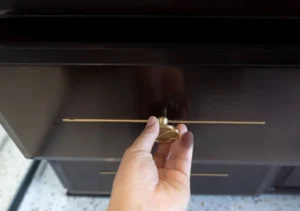
The first is warmth and texture: polished nickel, satin brass, unlacquered brass that’s allowed to age and darken naturally over time. Yena Jung, of New York’s By Yena Designs, told The Kitchn, has pointed out that bright, uniform polished brass — the kind that was everywhere a few years ago on pulls, faucets, and even door hardware — is starting to feel oversaturated on its own, which is pushing designers toward warmer but less shiny versions of the same metal family.
The second direction goes the opposite way entirely. Jennifer Jones, principal designer of Niche Interiors, has been specifying slim, minimal hardware that’s designed to visually disappear, replacing the chunky statement knobs that were popular even recently. Her reasoning ties back to the same idea driving panel-ready appliances: in a small kitchen, limiting the number of distinct materials and finishes in the room makes the whole space read as larger, because there’s less for the eye to catalog.
So the honest answer on hardware in 2026 isn’t “get this specific finish.” It’s that both a warmer, textured statement pull and a nearly invisible slim pull are legitimate choices right now, and the wrong move is landing in the middle with something shiny, chunky, and matte black — the exact look that’s aging fastest.
What’s Fading Out, Even Though It Was Everywhere Last Year
A few looks that were genuinely popular going into 2026 are already showing wear, according to designers who spoke to Homes & Gardens about what they’re actively moving clients away from:
- Fully fluted cabinetry. Kathy Kuo has said the texture is real and the appeal made sense, but most fluted cabinet fronts are finished in veneer rather than solid wood, which doesn’t hold up as well over time. Designer Allison Lind’s take is more about restraint than material: fluting works as an accent on a few drawer fronts or a curved island edge, not wrapped around every door in the kitchen.
- Over-grouted stone slab backsplashes. The heavy-grout, large-format stone look photographed beautifully for a while, but Sadie Beachy, of S. Flynn Design + Build, points out it only actually suits homes whose architecture supports that European, rustic feel — applied to a kitchen that doesn’t match, it reads as a costume rather than a design choice.
- Fully smart, app-connected appliances. This is a genuine reversal. Maggie Griesbeck, of MNG Design, has clients actively asking to remove the need to use a phone to run basic kitchen functions — they want a button, not an app, and that preference is showing up more with older clients specifically.
- Oversized kitchen islands. Not relevant to most small kitchens by definition, but worth knowing if you’re weighing whether to force one in: designer Laura Stephens has seen the appeal shift away from scale-for-its-own-sake toward smaller, more flexible pieces — which lines up with the portable work table trend below.
- The ultra-minimal, fully-concealed kitchen. Laura Stephens again: rows of handleless cabinetry with nothing to distinguish one kitchen from the next is starting to feel less like restraint and more like a kitchen with no personality left in it.
None of these are “wrong” if you already have them and like them — living with them day to day matters more than chasing a shift in an industry that resets its opinions every year. But if you’re deciding what to change in a small kitchen this year, these are the finishes worth skipping over for something with more staying power.
Portable Work Tables Instead of a Squeezed-In Island
A built-in island is one of the design rules small kitchens are increasingly allowed to ignore outright, mostly because it usually doesn’t fit without wrecking the walkway. What’s replacing it, according to the same Homes & Gardens small-kitchen trend report, isn’t nothing — it’s a portable work table or a slim kitchen cart on castors, positioned in the center of the room when you need the surface and rolled out of the way when you don’t.
The appeal isn’t just practical. A vintage-style work table on wheels brings a collected, furniture-like feel that a built-in island can’t, since it doesn’t read as a fixed architectural feature. It’s also the rare small-kitchen trend that requires zero renovation — you can try it, live with it for a month, and return it if the room doesn’t work with it. A workstation sink, which comes with built-in ledges for a cutting board or drying rack directly over the basin, does a version of the same job for counter space specifically, without needing floor space at all.
Trying These Trends on a Smaller Budget
Not everything on this list needs a contractor. Hardware is the cheapest swap here, and a mirrored backsplash panel or a checkerboard-painted floor can both be weekend projects rather than renovations. Annie Kantor, founder of Modern Metal, told Real Simple that decorative cabinet inserts have specifically taken off as a lower-commitment way to change a kitchen’s whole face without touching the cabinet boxes underneath.
For the full breakdown of budget-friendly styling moves — hardware, inserts, peel-and-stick materials, and where to actually spend if you’re ready for more — these kitchen decor ideas and this guide to high-impact small kitchen renovations cover that ground in more depth than fits here.
Where to Start
If you only take one thing from small kitchen trends 2026, make it this: the direction this year isn’t about tricking the eye into thinking a room is bigger than it is. It’s about making deliberate material and color choices, hiding what doesn’t need to be seen, and being honest about which of the two hardware camps actually fits how you use the room. A kitchen doesn’t need to chase every shift on this list to feel current — picking two or three that genuinely fit your space will do more than trying all of them at once.