Backyard Ideas on a Budget: The 2026 Zone Method for a Yard That Feels Bigger
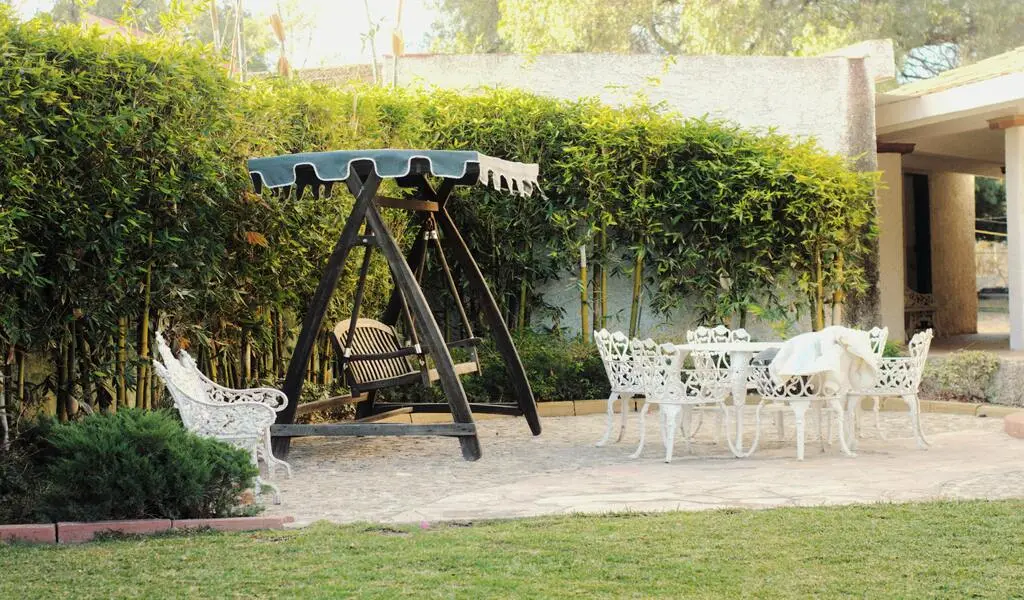
Buy a fire pit. Buy some string lights. Grab a rug, a couple of chairs, maybe a planter or two. Six months later the yard has all of it, and somehow still looks like a yard sale that never got picked up. That’s the actual failure mode behind most budget backyard projects, and it has nothing to do with how much any of it cost.
Landscape design research from NC State Extension and University of Minnesota Extension points to the exact same pattern showing up over and over: people buy the furniture and decor first, then go looking for a layout to put it in. The sequence runs backward. A yard doesn’t need more stuff to stop feeling like a pile of nice things scattered on grass — it needs a plan for where each thing belongs, decided before any of it gets bought.
That’s what this guide actually walks through. Real backyard ideas on a budget, organized around a genuine landscape design principle instead of a shopping list, using a simple zone-based method that professional designers already rely on for small residential yards.
Why Budget Yards End Up Looking Unfinished
Nobody sets out to buy things randomly. It just happens gradually — string lights on sale in spring, a fire pit kit that looked good online in June, a rug picked up on a whim in July. Each purchase is reasonable on its own. Laid out together with no shared plan, they read as clutter instead of a finished space, no matter how nice each individual piece actually is.
The fix isn’t spending more. It’s deciding on the layout before buying anything else, which is the exact opposite of how most budget backyard projects actually unfold.
Think in Rooms, Not Objects
Professional landscape designers use a concept sometimes called “outdoor rooms” — treating each section of a yard the same way you’d treat a room inside the house, with a floor, a boundary, and something overhead defining the top of the space. It sounds almost too simple to matter. It’s the entire reason some small yards feel organized and calm while others feel like a lawn with objects dropped onto it.
Every zone in a yard needs those same three layers, scaled down to whatever the budget allows. The floor defines where the zone physically sits. The boundary tells your eye where one zone ends and the next begins, without needing an actual wall. The overhead layer is what makes a space feel enclosed and intentional rather than exposed and incidental. Skip any one of the three, and the zone reads as unfinished even if every individual object in it was chosen well.
Defining the Floor of Each Zone
This is the cheapest layer to get right, and it does more visual work than people expect from something you mostly walk on without noticing.
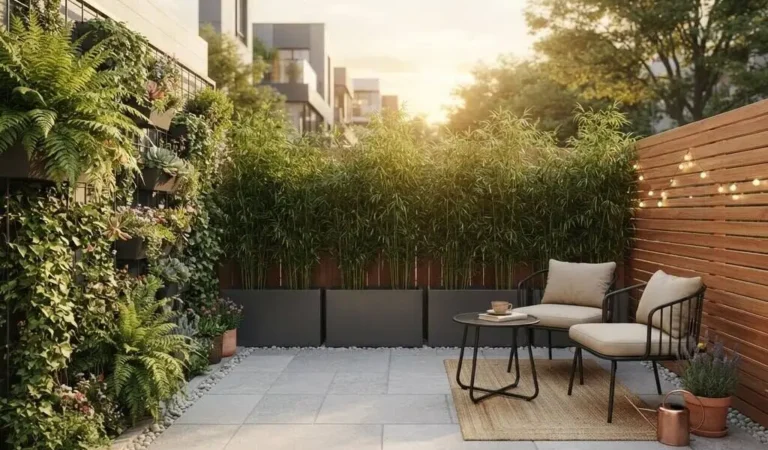
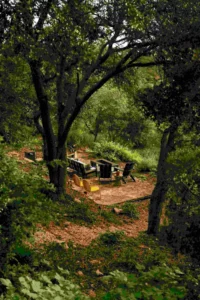
A patch of gravel, a few interlocking pavers, or even just a well-placed outdoor rug over grass tells your eye exactly where a zone starts and stops. Without that defined floor, furniture just sits in open lawn with no visual anchor, which is a big part of why a scattered set of chairs and a fire pit can look randomly placed even when the layout itself is perfectly reasonable.
Gravel is worth calling out specifically, since it’s one of the cheapest hardscaping materials available and installs without any special skill — spread it, rake it level, done. A cluster of simple furniture on a defined gravel patch reads as a considered outdoor room. The same furniture loose on grass, a few feet away, reads as things that haven’t found a home yet.
Marking the Boundary Without Building a Fence
A zone’s boundary doesn’t need to be solid to work. It just needs to be visible enough that your eye registers a clear edge.
A simple lawn edge cut between a gravel zone and the surrounding grass does this job for almost nothing — a half-moon edger and an afternoon of work creates a crisp line that separates “this is the seating zone” from “this is just yard.” Low plantings along one side of a zone accomplish something similar without needing a structure at all. The goal here is purely visual definition, not privacy — if blocking sightlines from neighbors or the street is the actual priority for a specific section of the yard, that’s a taller-planting or screening project in its own right, covered in more depth in this backyard privacy guide, since the two problems call for genuinely different solutions.
Furniture arrangement itself can double as a boundary too. A pair of chairs angled to face each other, rather than lined up facing outward, creates a sense of enclosure on its own — the arrangement itself signals “this is a contained space” without a single additional object.
The Overhead Layer Most Budget Yards Skip Entirely
This is the layer that gets neglected most often, mostly because it’s the one people don’t think about until the other two are already done — by which point the budget’s usually gone.
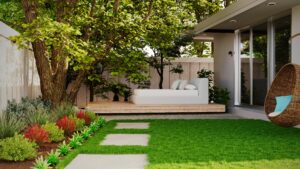
String lights do this job better than almost anything else at this price point. Strung across a seating zone at head height or just above it, they create a defined “ceiling” the same way a pergola or umbrella would, just without the cost or the installation. The visual effect matters more than people expect: a zone with an overhead layer, even a light one, reads as a finished room. The identical zone with open sky above it reads as unfinished, regardless of how good the furniture underneath actually is.
A portable market umbrella accomplishes the same thing during the day, and a simple canvas or fabric pergola cover does it for a slightly bigger investment. The specific method matters less than making sure every zone has some kind of overhead definition, even a minimal one.

Every Zone Needs One Thing to Look At
Once a zone has its floor, its boundary, and its overhead layer, it needs a single focal point — one object the eye naturally lands on rather than several competing for attention at once.
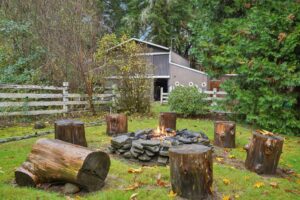
The fire pit has become the single most common answer to this in 2026, and for good reason. It works as a genuine focal point during the day, functions as usable heat and light after dark, and naturally pulls furniture into a circle around it, which does the “boundary” job described earlier almost automatically. A simple ring built from stacked concrete blocks accomplishes this on a real budget, without needing anything elaborate.
A focal point doesn’t have to be a fire pit specifically. A single striking planter, a small water feature, or even one well-placed piece of furniture with a distinct shape can do the same visual job. What matters is restraint — one clear focal point per zone, not three or four competing for the same attention.
Why This Actually Makes a Small Yard Feel Bigger
This is the part most budget-decor advice skips entirely, and it’s the actual mechanism behind “feels bigger,” not just a phrase attached to a title.
A single undefined lawn with furniture scattered across it reads as one space that never quite works, because the eye has nothing to organize it around. Two or three clearly defined zones — each with its own floor, boundary, and focal point — read as a series of usable, purposeful spaces instead. Counterintuitively, breaking a small yard into distinct rooms makes it feel larger than leaving it as one open, undefined area, because there’s more for the eye to register and move through. A yard that reads as “one blurry space” feels smaller than the exact same square footage divided into rooms that each have a clear purpose.
This is the same underlying idea real landscape designers use on much larger properties, just scaled down to whatever a small backyard budget can actually support.
Where the Budget Actually Goes First
Floor definition first, since it’s the cheapest layer and does the most to stop furniture from looking randomly placed. Boundary marking second — a lawn edge or a simple furniture arrangement, both close to free. The overhead layer third, since string lights are inexpensive but the visual payoff is disproportionately large for the cost. The focal point last, once the rest of the zone already has a reason to exist around it.
Skipping straight to the focal point — buying the fire pit first, then figuring out where it goes — is the exact reversal that leaves a budget yard looking scattered no matter how much gets spent on it.
Once the core zones are working, the natural next additions tend to be a planting zone — container gardening works well for this without committing to anything permanent — or a dedicated privacy zone if a specific corner of the yard genuinely needs it. Neither is required to make the core of the yard feel finished. They’re additions to a layout that already works, not a substitute for having one in the first place.
That’s really the whole difference between a yard full of nice things and a yard that actually feels designed: not the money spent, but whether each zone had a floor, a boundary, and something overhead before a single object went into it.